top of page

Elephant in the Room
The Air Purification Mystery
Olivia Femino
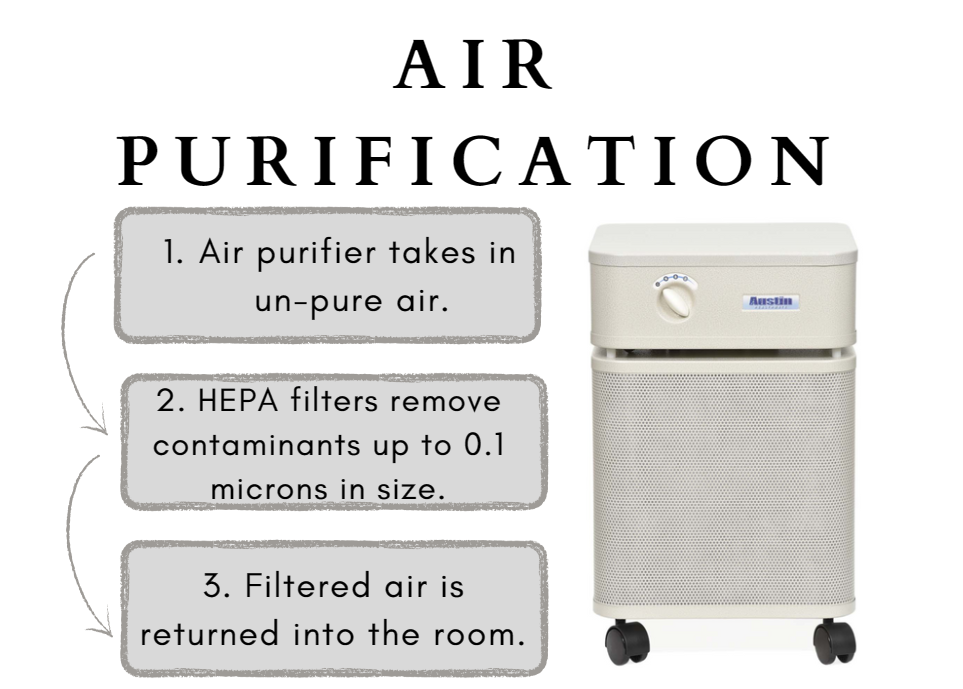
Air purification infographic
Graphic by Isabella Murphy.
March marked the fourth anniversary of schools shutting down due to the COVID-19 pandemic. Four years later, classrooms still feature noisy little carts that appeared after quarantine: air purifiers.Besides being distracting and obstructing paths, have you ever wondered what the air purifiers really do?
During the COVID-19 pandemic, summer was coming to an end and school was about to be back in session. Everyone in the world had one thing in common–they did not want to get sick. So as the school year rolled around, all of these air purifiers started popping up in classrooms, promising clean air for students and teachers.
According to Chris Hayden, Director of Facilities of the town of Milton, “The main purpose of obtaining these High Efficiency Particulate Air (HEPA) filters was to help clean the air and to assist in the Air Change per Hour (ACH) rate that takes place in your classroom already by mechanical equipment on the rooftop of the school.”
According to Hayden, “In a 30-foot by 30-foot classroom that has 25 students in it, the air should be replaced every 15 minutes.” The purpose of the air purifiers is to make sure that the air coming into the classrooms is clean and sanitized.
But how do the air purifiers remove these toxins from the air? Hayden explained, “It was determined that room air purifiers equipped with HEPA filters would be helpful in office and classroom settings to filter the air of 99.97% of air particles including virus and bacteria which includes the SARS-CoV-2 (COVID-19) virus microns.”
Microns are the units used to measure viruses or any kind of air particles. The HEPA filters are designed to remove contaminants up to 0.1 microns in size, so the purifier is entirely able to remove the COVID-19 virus which is 3-5 microns in size, making it a great tool for schools and workplaces.
One of the big problems that comes with purchasing one of these air purifiers is keeping up with its maintenance. For example, if the filters are not changed in a certain amount of time, there is a chance they will break and release all the contaminants collected back into the air. According to NewsinHealth.gov, this can cause respiratory problems such as “flare-ups of allergy or asthma,” making the classroom environment unsafe for some students and staff.
As reported by Hayden, “According to the manufacturer the filters last up to five years before needing replacement. These Austin units were purchased in December of 2020 and installed in schools and were operational in January 2022.”
To cut down on labor costs Hayden decided on the Austin-branded air purifiers considering the filters need to be changed only every five years as opposed to every one year.
It has been four years since COVID-19 began, so are these utilities still a benefit to classrooms? “Essentially, they are beneficial,” said Hayden. “They keep the air within the classroom clean.”
Even though COVID-19 feels over, these purifiers are still important because they keep the classroom environment safe. As they remove toxins from the air, they create an easy-to-breathe environment for students and teachers, making Milton High safe and comfortable.
bottom of page