top of page

Elephant in the Room
Saint Rock Haiti Foundation - Milton Service in Saint Rock
Adam Cheairs and Melina Zullas
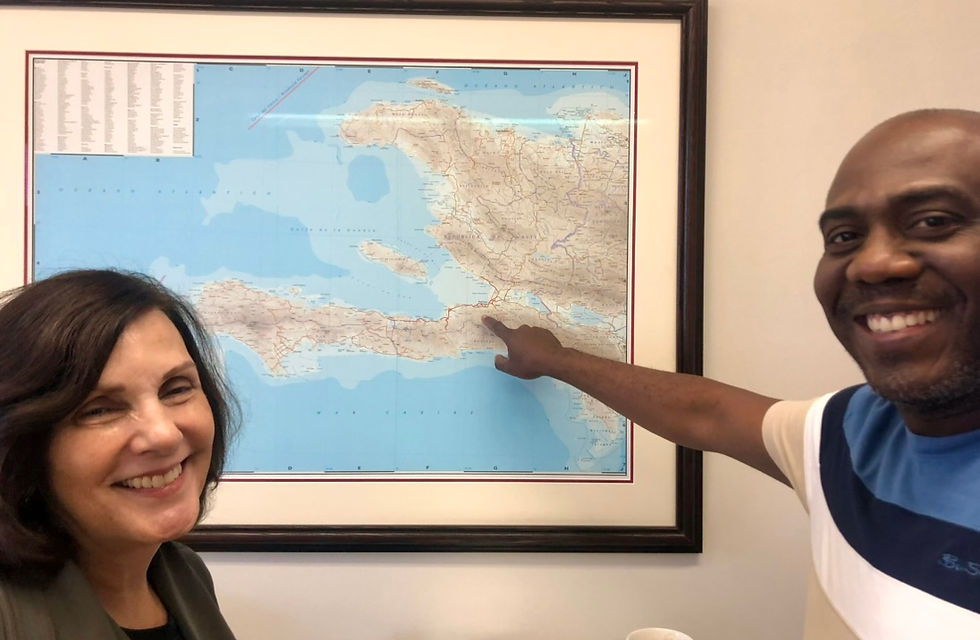
From a modest office in East Milton Square, president Jocelyn Bresnahan and Country Director Dr. Jean Kenes Eloy help guide the work of the Saint Rock Haiti Foundation.
Photo By Adam Cheairs
When immigration enters public conversation, it usually appears at the end of the journey. A family arrives. A student enrolls in school. A city absorbs the change. What rarely enters the story is what came before, the slow accumulation of conditions that made leaving feel necessary in the first place.
Saint Rock, a rural community outside Port-au-Prince, Haiti, sits earlier in that story.
Reaching the United States often requires difficult sacrifices. According to the Migration Policy Institute, hundreds of thousands cross the Darién Gap between Colombia and Panama, the dense and tangled 60-mile overland link between South and Central America, in order to begin a new life without political instability, economic crisis, devastated infrastructure or widespread gang violence.
The largest, most sustained influx of Haitian immigrants began in the late 1970s and has continued into the 21st century, driven by political instability and economic hardship following the 2010 earthquake.
About 731,000 Haitian immigrants live in the United States. Many have made Milton, Massachusetts their home. The Immigrant Family Services Institute in nearby Boston has estimated it assisted 14,000 new Haitian immigrants between 2022 and 2024. This number has begun to show in Milton schools and homes, where members of the community have provided them with shelter.
“I think that Haitian families end up choosing Milton because of the French immersion program,” explained Dr. Edgar Canty, the English Language Learning teacher at Milton High School. Milton’s program is one of three in New England and begins in first grade. “And because of how close it is to the city of Boston,” he added.
For more than twenty years, Milton has been linked to Saint Rock through the Saint Rock Haiti Foundation. The organization does not describe itself as working on immigration, but it works in the terrain that precedes it: healthcare, education, and the conditions that widen or narrow people’s choices.
The foundation began in 2002 after its founder, Ralph Stowe, a Boston Public Schools teacher, spent time in Saint Rock and asked residents what they wanted to build. Stowe returned to Haiti in 2003 with a group of Boston-based health professionals and volunteers from Milton’s Saint Agatha Parish.
According to Jocelyn Bresnahan, the foundation’s president, the answer was straightforward.
“At the time, it was healthcare,” she said.
There was no clinic nearby. A partially constructed building was completed, and in 2004 a small healthcare center opened. About one hundred patients were registered that first year. The clinic was modest and reliable. It never closed.
Dr. Jean Kenes Eloy arrived in Saint Rock in 2008 as a physician. Trained in general medicine, he had worked with Haiti’s Ministry of Health and international organizations before joining the foundation. He stayed as the clinic expanded, eventually becoming medical director and today, Country Director.
Dr. Eloy does not talk about transformation in sweeping terms. He talks about routine.
Patients come knowing the clinic will be open. They pay a small fee and receive consultation, lab services, and medication in one visit. Prenatal care, vaccinations, and general medicine make up the rhythm of the day. 75% of the patients, he said, are women and children.
“The people we serve make less than two dollars per day,” Dr. Eloy said.
In that situation, illness does more than disrupt health. It interrupts work, pulls children out of school, and narrows options. Access to care does not solve everything, but it stabilizes enough that life can continue.
From Milton, Bresnahan supports the work with a small U.S. staff. She first traveled to Saint Rock in 2007 on a volunteer trip, accompanied by her eldest daughter, then a high school junior. She returned months later with her husband and their other children. Over time, her role shifted from volunteer to board member to president, overseeing U.S. operations while working alongside Haitian leadership.
“We look at ourselves as walking alongside our staff in Haiti,” Bresnahan said.
That matters most when conditions are unstable. The clinics have continued operating through periods of violence, supply shortages, and restricted movement, not because Saint Rock is insulated from those realities, but because it is embedded in the community.
Dr. Eloy said instability “absolutely” affects the work. “There is a lack of medication in the country due to the situation, and it is more difficult to move from point A to point B.” What allows the work to continue, he explained, is constant coordination at the local level.
“We continuously collaborate with all the authorities,” Eloy said, including the Ministry of Health and local officials. “We also work with community leaders, like pastors and Oungans. We collaborate with all of them.” Those relationships are practical. Community leaders alert staff when conditions are shifting and when adjustments need to be made.
Healthcare was the foundation’s starting point. Education followed.
Schools supported by the foundation once struggled to retain teachers because salaries were unreliable. When pay became consistent, attendance improved and students stayed in school longer. Over time, exam pass rates rose above the national average five times over. More importantly, graduates began returning to Saint Rock as professionals.
“Now we are seeing very good results,” Dr. Eloy said. “Our graduates are working in the community as physicians, dentists, and engineers.” One of them helped design a new school in the area.
None of this guarantees that people will stay. Some leave Saint Rock for Port-au-Prince. Some leave Haiti altogether. But because of the work of the foundation, it is no longer the only imaginable future.
Bresnahan is careful not to overstate that point. “We are trying to help people who do not have the financial choice or the opportunity to emigrate,” she said.
Haitian-American families maintain close ties to Haiti and where immigration is often experienced as arrival rather than origin. The foundation works closely with Haitian Americans United and includes members of the diaspora in its advisory and leadership circles.
Dr. Eloy did not soften the importance of those connections. “Without the diaspora,” he said, “Haiti would collapse.”
bottom of page